
How to get started with Google Ads - key take aways
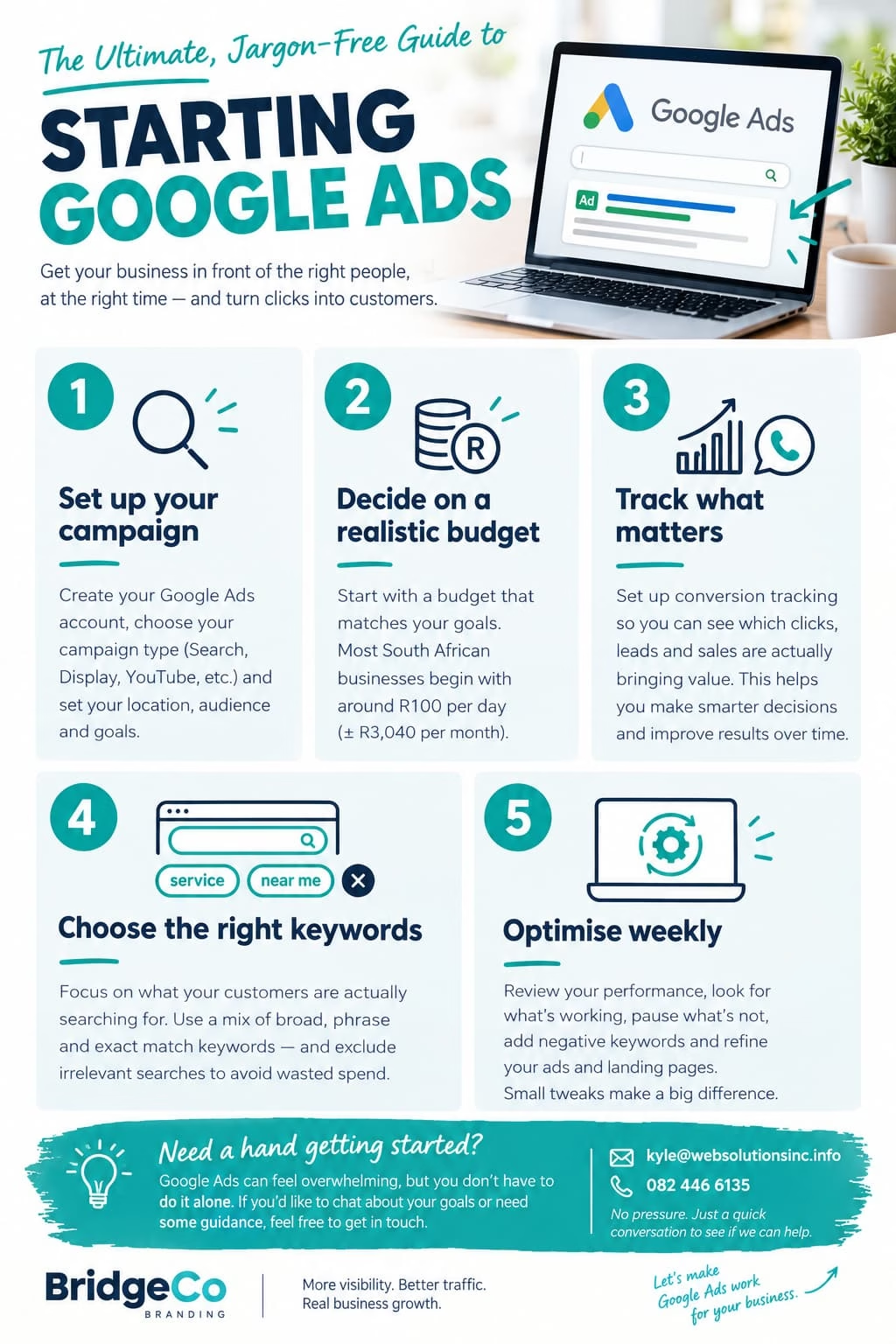
- How it works: You bid on searches, and you pay only when someone clicks.
- Where to start: Run one Search campaign before you touch Performance Max.
- Budget: Start near R100 a day (about R3,040 a month) so Google gathers usable data.
- Tax: Google adds South African VAT to your costs, so budget for it.
Intro
Google Ads puts your business in front of people at the exact moment they search for what you sell. Google Ads is Google's paid advertising platform, and you only need to pay if someone clicks on your ad.South Africans search before they buy. DataReportal counted 51.7 million internet users in South Africa in October 2025, and plenty of them ask Google for a plumber in Durban North, a bakkie hire in Centurion or a wedding venue near Stellenbosch before they phone anyone.Most beginners either freeze at the jargon or burn through rands in the first week. This guide fixes both problems. You will learn what each term means, what a sensible rand budget looks like, which campaign type to pick and how to track every lead. Read it once, then build your first campaign this week.
How does google ads work
Google Ads is an auction. You choose search phrases, set a budget and write an ad. Google shows your ad when someone searches those phrases, and you pay only for clicks. Google ranks competing ads by your bid and by quality, so a sharp small advertiser can beat a lazy big one.
How much does Google Ads cost in South Africa?
Start with about R100 a day, or roughly R3,040 a month. You control the ceiling, and Google charges only when someone clicks.
- Set your budget the Google way. You choose an average daily budget. Google may spend up to double that on a busy day, yet it never bills you more than 30.4 times your daily figure in a billing period.\
- Expect clicks to vary wildly. One South African comparison site reports cost per click from about R5 to over R200, depending on how fiercely rivals bid.
- Budget for VAT. Google's tax help page confirms that South African accounts attract VAT at the local rate. Prepay accounts lose VAT from the balance at month-end; postpay accounts get it added to the bill. If you are VAT-registered with SARS, ask your accountant about claiming it back.
- Pick your currency carefully. Google lets you set the currency once, and you can't change it later.
- Try this illustrative example. At R10 a click, R100 buys ten visitors a day. If five percent enquire, you earn one enquiry every two days at R200 each. Your numbers will differ; the sums stay the same
Which Google Ads campaign type should I start with?
You can choose a Search campaign to start with. It shows text ads to people already typing what you sell, so every rand targets existing demand. Service businesses suit it well: a Durban plumber, a Joburg accountant and a Cape Town guesthouse can all start here.Add Performance Max later. Google designs it to complement Search campaigns, and it optimises towards the conversions you track, so it needs data first. Beginners who launch it on day one hand Google control before they know what a good lead costs.Talk to our Google Ads management company in South Africa. We can help you choose the right campaign for your business.
Set up conversion tracking before you spend a cent
If you skip this step, you are flying blind. Conversion tracking tells Google Ads exactly when a click turns into a valuable lead. Without it, you will never know which keywords make you money and which ones just drain your budget.
A conversion for a South African business usually looks like one of these:
-
A completed "Contact Us" form on your website.
-
A click on a WhatsApp chat button (hugely popular in SA).
-
A click on your phone number from a mobile device.
-
An online purchase (if you run an e-commerce store).
You can set up tracking using a free tool called Google Tag Manager or by linking your Google Analytics 4 (GA4) account to your Google Ads account. If the tech feels overwhelming, pay a freelancer for an hour of their time to set this up for you. It is the best investment you will make.
How to choose keywords without wasting money
When you build your Search campaign, Google will ask you to input keywords. The biggest rookie mistake is using "Broad Match".
If you type plumber Pretoria into Google Ads as a Broad Match keyword, Google thinks it has permission to show your ad for loosely related terms. You might end up paying for clicks from people searching for "plumber jobs in Pretoria", "how to become a plumber", or "free DIY plumbing tips".
Instead, use Phrase Match or Exact Match:
-
Phrase Match: Put quote marks around your keywords, like "plumber Pretoria". Your ad will only show if the user's search includes the meaning of your phrase (e.g., "emergency plumber Pretoria" or "hire a plumber Pretoria").
-
Exact Match: Put square brackets around your keywords, like [plumber Pretoria]. Your ad will only show for searches that match that exact intent.
Protect your budget with Negative Keywords
Negative keywords are the unsung heroes of a profitable Google Ads account. These are the words you explicitly tell Google not to show your ads for.
Before you launch, create a negative keyword list containing words like:
-
Jobs, vacancies, hiring, learnerships (you want customers, not job seekers).
-
Free, cheap, DIY, how to (these searchers are not ready to pay).
-
Gumtree, Facebook, Takealot (people looking for specific platforms).
Writing ads that people actually click
Google uses "Responsive Search Ads". This means you get to write up to 15 different headlines and 4 descriptions, and Google’s algorithm automatically mixes and matches them to find the combination that works.
To write a great ad, follow these three rules:
- Mirror the search: If someone searches for "bakkie hire Centurion", make sure "Bakkie Hire Centurion" is one of your main headlines. Doing this proves to the searcher that you have exactly what they need
- Highlight your edge: Why should they click you? Mention "No Call-Out Fee", "Same-Day Delivery", "B-BBEE Level 1", or "20 Years Experience"Use Assets (formerly Extensions): These make your ad physically bigger on the screen. Always add Sitelinks(links to other pages on your site), Callouts (short bullet points of your benefits), and Call Assets (your phone number so people can dial you directly from the search results).
The weekly habit: Optimising your campaign
Google Ads is not a "set it and forget it" machine. If you leave it alone, your performance will slowly degrade. Set a recurring weekly calendar invite for 30 minutes to do one crucial task: Check your Search Terms Report.
While your "Keywords" are what you asked Google to target, your "Search Terms" are the exact phrases real people typed into Google before clicking your ad.
When you read this report:
-
If you see a great search phrase that resulted in a lead, add it to your Keywords list.
-
If you see a terrible search phrase that wasted money, add it to your Negative Keywords list.
The Bottom Line
Starting Google Ads doesn't require a marketing degree. It requires a logical setup, a strictly controlled budget, and the patience to look at your data once a week. Start with a R100-a-day Search campaign, make sure your conversion tracking is working, and that you are using the keywords that get you found by your customers.
Running Google Ads yourself means no management fee, but it takes your time and a learning curve. Hiring a South African digital agency adds a management fee (a flat monthly amount or a percentage of ad spend) in exchange for specialist management, tracking and reporting. In both cases you still pay Google for ad spend. The table compares cost, time, expertise, control, speed, scalability and risk.
| Comparison point | Running Google Ads yourself (DIY) | Hiring a South African digital agency |
|---|---|---|
| Monthly cost | No management fee. You pay only Google for ad spend, plus the value of your own time and any tools you subscribe to. | Ad spend plus a management fee. Agencies commonly charge either a flat monthly fee or a percentage of ad spend (often quoted at 10–20%), and some add a once-off setup fee. Ask for the full first-month cost in rand, in writing. |
| Time required | Expect regular weekly hours reviewing search terms, adjusting bids, testing ad copy and checking reports. That time comes out of running the rest of your business. | Your time is mostly limited to approving the budget, giving feedback on lead quality and reviewing monthly results. |
| Expertise and learning curve | You learn on your own budget. Common beginner mistakes include loose keyword match types, missing negative keywords and wrongly set conversion goals, all of which can waste ad spend. | You get specialists who manage many accounts and see patterns across industries. Quality varies between agencies, so ask for relevant case studies, client references and Google Partner status. |
| Conversion tracking and reporting | You set up and maintain Google Analytics 4, Google Tag Manager and call or form tracking yourself. If tracking is wrong, Google Ads optimises towards bad data. | Tracking and reporting are usually set up during onboarding and summarised in a monthly report. Check that the report shows leads, cost per lead and sales, not only clicks. |
| Control and account ownership | You have full control, see every rand spent and can change campaigns immediately. The Google Ads account is yours from the start. | Control depends on the agreement. Make sure the Google Ads account is in your business's name, you have admin access, and the contract explains what happens to your data if you leave. |
| Speed to launch and results | You can launch within days, but campaigns still need a learning period while Google collects data and you refine targeting. | Onboarding, an account audit and setup take some time before launch. The first month is typically a learning phase, with results improving as optimisation uses real conversion data. |
| Scalability | Easy at small scale. As you add Search, Performance Max, remarketing or more locations, the workload grows beyond what one busy owner or staff member can handle well. | A team can add campaigns, channels and landing page tests as budgets grow. Management fees may increase with ad spend or scope. |
| South African market knowledge | You know your own customers, pricing and service areas best, but you may lack benchmarks for local competition, rand-based budgets and cost per click in your industry. | A South African agency should understand local search behaviour, city and province targeting, rand budgets and handling lead data in line with POPIA. Ask for examples from South African clients. |
| Minimum ad spend and budget fit | Works for small budgets, but low spend produces data slowly. Some South African agencies suggest around R3,000–R5,000 per month in ad spend for a meaningful test. | A management fee on a very small ad budget can cost more than the ads themselves. Agencies suit businesses whose ad spend is large enough for the fee to be a reasonable share of total spend. |
| Main risk | Wasted ad spend from setup errors, and no outside review of the account. | Long lock-in contracts, templated work, and reporting that focuses on clicks rather than leads or sales. Ask about contract length, notice period and how success is measured. |
| Best fit | Choose DIY if you have a small ad budget, time to learn Google Ads, and a simple offer in one location or service area. | Choose a South African digital agency if you have a larger or growing ad budget, little time to manage campaigns, and want tracking, reporting and ongoing optimisation handled for you. |
Last reviewed . Fee ranges are general guides, not quotes. Request written quotes in rand (ZAR) from any agency you consider.