
Table of Contents
Key Takeaways
- From Keywords to Entities: Search platforms now index distinct concepts and real-world entities rather than isolated text strings.<>
- The Post-Google Shift: Consumers split their discovery journeys across generative AI engines, device assistants, and social networks.
- Context is King : Winning local search results means aligning your content with specific geographic realities and user needs.
- Measurable Authority Beats Hype: Building structured content hubs lowers client acquisition costs and increases high-intent service inquiries.
Intro to semantic seo
For more than two decades, traditional search engine optimisation depended on a relatively simple formula: find a high-volume keyword, stuff it into your headings, and repeat it enough times to convince a computer that your webpage was relevant.Step into 2026, and that rigid approach falls entirely flat.
Search algorithms don't work like this anymore. Instead, modern platforms function as highly intuitive cognitive networks driven by machine learning, natural language processing (NLP), and multi-platform synthesis. Enter Semantic SEO—an enhanced optimisation method concentrating on user intent, contextual depth, and the relationships between concepts rather than isolated search phrases.
Your brand risks going unnoticed if you are over relying on keywords in 2026. Our blog explains what semantic seo means today and why Google is no longer the only platform you should be optimising for.
What Is Semantic SEO and How Does It Change Search Technology?
You must look into how contemporary digital platforms interpret human language in order to understand the technological change. Web pages were seen as collection of individual words in traditional optimisation. Modern search architecture assesses online content according to purpose and entity.
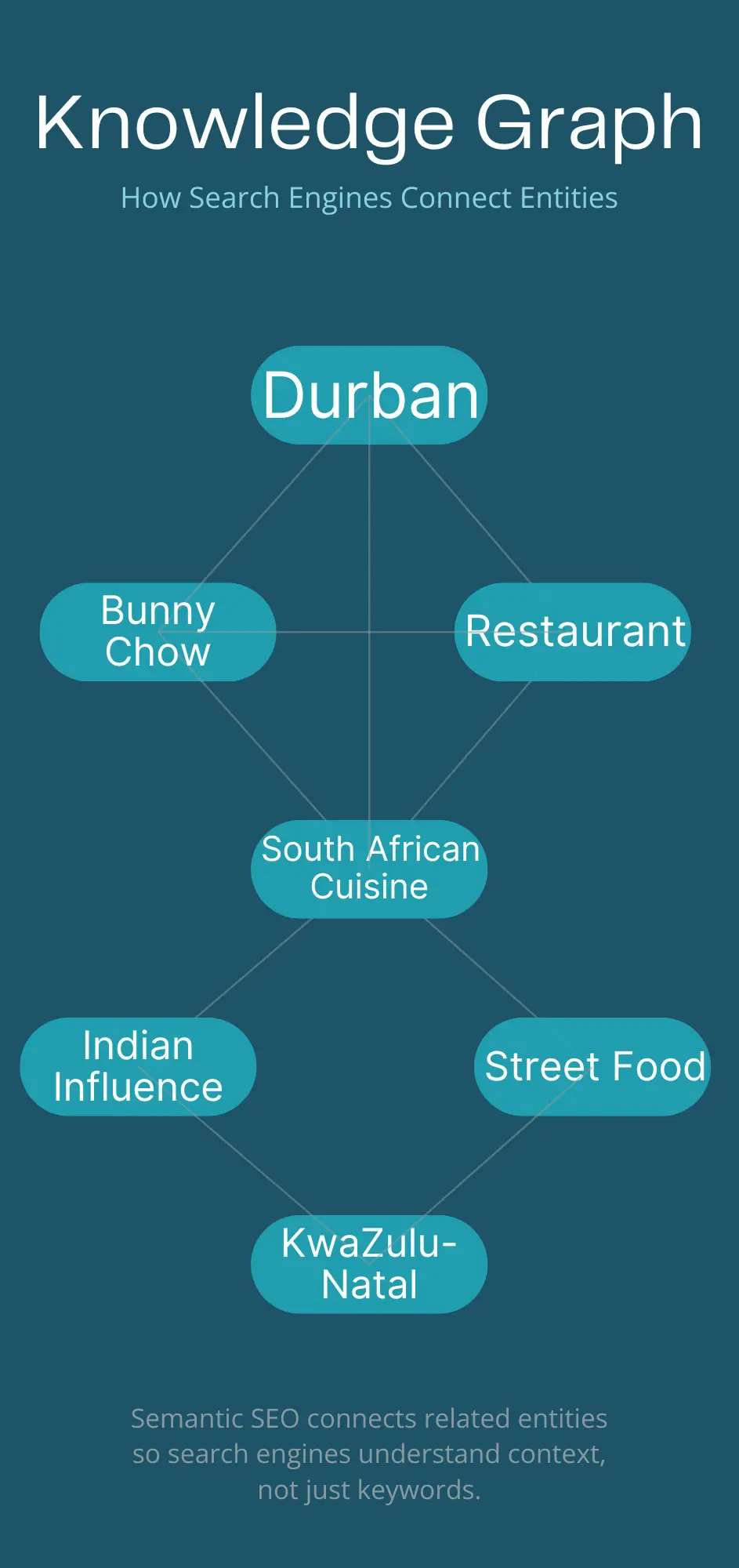
An entity is any clearly defined distinct concept, person, place, organisation, or object. When a user conducts a query, discovery engines map out the connections between these entities using complex knowledge graphs. For a look at how this network structure operates, you can explore the technical overview of the Semantic Web on Wikipedia.
Intent-Driven Marketing makes sure that your digital platform explicitly defines the relationships between various concepts, satisfying a user's underlying intent by building a deeply interconnected web of content that covers an entire topic thoroughly.
For example think about how people actually speak. People will rarely use fragmented keywords like best restaurant durban food , when it comes to voice automation they might ask where can I find the best bunny chow in durban after 8pm? Contextual search design ensures that people don't just look for the word bunny chow The system understands that bunny chow is a South African delicacy. By understanding this your company becomes the citable answer.
SEO Methodology Paradigm Matrix
Core Focus
Specific keyword phrases and repetition density
Entities, context, and user intent matching
Content Structure
Isolated blog posts targeting single words
Comprehensive content clusters and topic hubs
Discovery Mechanism
Text string matching
Knowledge graph mapping and conceptual relationships
Primary Goal
High search engine results page (SERP) rankings
Multi-platform discovery and definitive topic authority
Where Are Durban Customers Searching in 2026?
A common mistake made by local business owners is viewing search through a single corporate lens. While Google historically dictated the rules of the internet, the modern user journey has fractured into a decentralized ecosystem. This reality is known as Search Everywhere Optimization.
Consumers split their discovery behavior across several distinct networks:
Generative AI Platforms
Lots of users bypass traditional search engines entirely. They query ChatGPT, SearchGPT, Perplexity, and Gemini for direct answers, product comparisons, and tailored advice. These systems rely heavily on Retrieval-Augmented Generation (RAG), which is a process where AI finds specific facts from the web to answer a question.
Apple Intelligence and Android's integrated assistants synthesize information directly from the web. They provide hands-free local recommendations based on immediate proximity and implied user intent.
Social and Visual Search Platforms
Younger demographics use TikTok and Instagram as the main discovery tools for lifestyle, hospitality, and retail services. They prefer experiential video over text-based directories.
Community Footprints
Platforms such as Reddit and local community forums have seen an iunxrease in organic visibility. Modern algorithms recognise that users crave authentic human experiences and real discussion over corporate marketing fluff.
These fresh approaches collect information from multiple websites to giver the user an overview. If companies keep relying on the old way of doing things they will simply be overlooked by ai search engines.
Why Does Topic-Based Authority Matter for KwaZulu-Natal Enterprises?
Owning or manging a successful company in Durban needs an intimate understanding of our local culture, climate, and geography. Durban has a unique micro-market where generic, mass-produced digital content fails to convert leads.
When a homeowner in Durban searches for a property solution, or a procurement manager in the south oif Durban looks for an industrial supplier, their intent is shaped by local realities. Our intense coastal humidity, specific infrastructure challenges, and distinct community layouts dictate what consumers value. For businesses looking to align with official regional development frameworks, studying the local infrastructure priorities on the
Topic-Based Authority let's your business address these localised things naturally. By creating content that explicitly addresses Durban-specific challenges, you signal to search engines that you are relevent in the sector.
How Do You Build an Intent-Driven Content Architecture?
Shifting from a keyword-centric mindset to a model focused on Topic-Based Authority requires a deliberate change in how you structure your online content. You cannot simply write a single blog post and expect long-term visibility. Instead, you must construct a comprehensive information architecture.
Develop Robust Content Clusters
Don't publish isolated articles that cover random, unrelated subjects. Organise your digital platform into logical hubs and spokes
-
Hub Pages: Create high-level, comprehesive guides that offer a broad overview of a primary service or product category.
-
Spoke Pages: Write in depth , narrowly focused articles that dive deep into specific subtopics, niche questions, or troubleshooting scenarios related to the main hub.
Contextual internal linking must connect your spoke pages back to the master hub using descriptive, natural anchor text. This architecture explicitly shows AI crawlers how your concepts are related.
How Do You Align Your Content with Local Search Intent?
Scrap the robotic, unnatural sentences that used to dominate the web. Focus entirely on clear, authoritative, and active prose. Structure your content around the four core types of user intent:
-
Informational Intent: The user wants to learn about a specific topic or fix a problem. For example: "Why is my air conditioner rusting so fast in Umhlanga?"
-
Commercial Intent: The user wants to investigate and compare available options. For example: "Best corporate catering companies in Durban Central Business District (CBD)."
-
Transactional Intent: The user wants to actively purchase a product or hire a service. For example: "Book emergency plumber in Hillcrest now."
-
Navigational Intent: The user wants to find a specific company's physical location or portal. For example: "Amanzimtoti (Toti) pool supplies phone number."
How Do You Technicalize Your Data with Schema App and Structured Markup?
Help machine-learning models categorize your enterprise by implementing advanced structured data. Schema markworks as a deigital translator telling AI crawlers precisely who you are, what services you offer, where your offices are located in KwaZulu-Natal, and what real customers say about your brand.
Use deployment tools like Schema App, you can build explicit entity relationships without touching complex code. To explore the standardized vocabulary used to build these entity maps, review the official documentation on