
Table of Contents
TLDR
What is Search Experience Optimisation and how do I apply it
Ask most South African companies if their seo and their website actually match, and you will get an awkward pause. That pause is the real problem. Search is changing fast moving away from just trying to rank on the first page and into AI summaries map listing and rich snippets.
Search experience optimisation explained
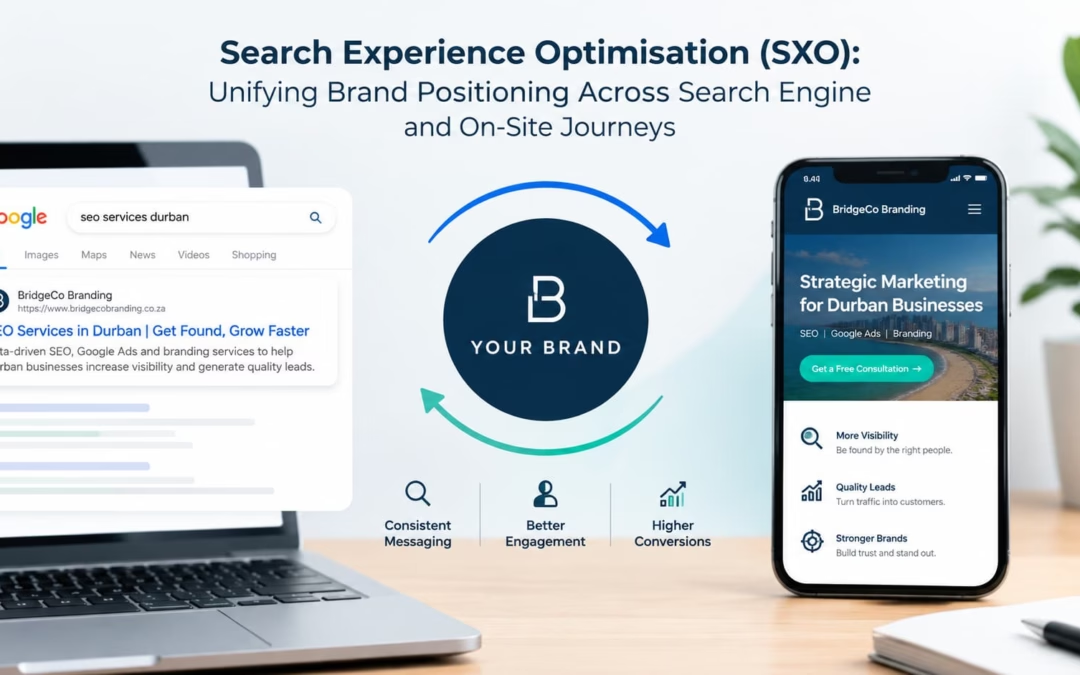
Search Experience Optimization (SXO) is the practice of designing a brand's search visibility and its on-site experience as one connected journey, rather than two separate workstreams owned by an SEO team and a web team. It combines classic SEO (getting found), UX (what happens once someone arrives), and CRO (turning that visit into an outcome) into a single strategy measured by search-to-conversion performance, not rankings alone.
The term has gained urgency because the "search" part of the journey no longer ends at a blue link. South African users increasingly encounter a brand first through an AI-generated summary, a map pack listing, or a rich snippet — each of which now carries brand-shaping weight before a single page loads.
How Is SXO Different From Traditional SEO?
Traditional SEO optimises for visibility; SXO optimises for the full arc from query to outcome, treating post-click behaviour as a ranking-relevant signal rather than someone else's problem.
Why Does Brand Positioning Consistency Matter Between Search Results and Your Website?
- Brand positioning consistency is crucial as search engine results pages (SERPs) reflect a brand's promise, and discrepancies lead to perceived broken promises.
- Consistent branding and design minimize visitor mental effort, enhancing trust and site navigation, particularly when a mismatch occurs between the snippet and the landing page.
- The rise of AI-mediated discovery further emphasizes this issue; research shows AI-generated summaries can lower click-through rates for traditional listings, especially for informational queries.
- When agencies use ai to write summaries they need to make sure it matches whats already on the page. If the ai uses a different tone it could end to visitors becoming confused and will leave your site fast.
- The SXO Alignment Score is a client audit metric assessing three factors: meta title/description coherence with on-page H1, visual identity alignment with snippet claims, and CTA consistency with query actions.•
- Low scores on this metric correlate with higher bounce rates and lower conversions, highlighting its importance as an indicator of performance.
South Africa's internet population reached 51.7 million users by the end of 2025, with online penetration at 79.6 percent (DataReportal) — a large enough base that inconsistent brand experiences are no longer a minor leak, they're a structural one. On top of that, South Africa leads the African continent in generative AI adoption, with roughly 23.1% of working-age South Africans using generative AI tools in a single quarter against a 17.8% global average (Microsoft Global AI Diffusion, Q1 2026, via GrowthPulse Media). For agencies managing South African brands, this confirms that AI-mediated discovery isn't a future consideration — it's already a meaningful share of how local audiences find and pre-judge a business before visiting its site.
What Does a Unified Search Experience Look Like Across the Customer Journey?
A unified search experience means every touchpoint a searcher encounters — from the SERP to the final on-site action — carries the same brand promise, in the same voice, with no gaps in what's claimed versus what's delivered.
Think of a South African retail or financial services brand appearing across these five touchpoints in a single journey:
How Can South African Agencies Build a Consistent SXO Strategy for Clients?
Agencies can build a consistent SXO strategy by auditing existing touchpoints against one brand source of truth, then rebuilding the weakest links first rather than optimizing everything at once.
- Agree on a core value proposition, tone, and three essential brand claims with the client. This establishes a singular brand source of truth for all SERP elements.
- Audit the SERP-to-page transition for priority pages. Extract current meta titles, descriptions, and featured snippets for the client's top 20 landing pages and compare them against actual page content.
- Rewrite content for both search crawlers and AI answer engines. Start each section with a direct, self-contained answer to anticipated searcher questions to increase the chances of citation in AI Overviews.
- Fix structural inconsistencies first, such as mismatched NAP data, conflicting pricing, and outdated offers. Address these before focusing on cosmetic changes to maintain trust.
- Test the mobile journey end-to-end using a mid-range Android device before finalising any page. This is very important given South Africa's mobile-first internet usage.
- Re-evaluate strategies quarterly instead of annually. AI Overview behaviour and SERP features change
What Metrics Should You Track to Measure SXO Success?
The right SXO metrics combine search visibility with on-site behaviour, since tracking either one alone hides where the journey is actually breaking down.What Are Common Mistakes That Break Brand Consistency Between Search and Site?
The most common mistake is letting the SEO team and the brand/design team work from different briefs, so the words that win the click and the words on the page were never meant to agree in the first place.
- Keyword-stuffed titles that don't match the page's actual headline or offer.
- Generic, templated meta descriptions that ignore the brand's actual tone of voice.
- Landing pages built for paid campaigns that contradict organic messaging for the same product.
- Outdated Google Business Profile details (hours, pricing, categories) left unreconciled with the website.
- Content written for rankings first, with no direct, quotable answer near the top — which also makes it far less likely to be cited inside an AI Overview.
- No shared glossary of brand terms, so "affordable," "premium," and "trusted" are used inconsistently across pages targeting the same audience.
Conclusion
This is where you find most of the marketing budget quietly leaking away for South African brands: between “being found” and “being trusted once found”. SXO closes that gap by treating the SERP, the AI Overview, the map listing, and the website as one continuous conversation with the same customer – not four disconnected channels each optimised in isolation.
How Is South Africa’s Search Landscape Changing in 2026?
South Africa's search landscape in 2026 is defined by near-total Google dominance, high internet penetration, and unusually fast AI adoption relative to the rest of the continent — all of which raise the stakes for a unified brand experience.
| Metric | Figure | Source |
|---|---|---|
| Internet users in South Africa (end of 2025) | 51.7 million (79.6% penetration) | DataReportal, Digital 2026: South Africa |
| Google's share of SA search market | Over 90% | GrowthPulse Media, SEO Statistics South Africa 2026 |
| SA adults who have used an AI chatbot | 70% | Google/Ipsos, cited in GrowthPulse Media |
| Working-age South Africans using generative AI (Q1 2026) | 23.1% (vs 17.8% global average) | Microsoft Global AI Diffusion, Q1 2026, cited in GrowthPulse Media |
| Queries triggering an AI Overview | Roughly 48% | BrightEdge, February 2026, cited in GrowthPulse Media |
| Figures compiled from the sources listed above; percentages are as reported by each publisher and not independently re-verified. | ||
South Africa's internet population reached 51.7 million users by the end of 2025, with online penetration at 79.6 percent (DataReportal) — a large enough base that inconsistent brand experiences are no longer a minor leak, they're a structural one.
On top of that, South Africa leads the African continent in generative AI adoption, with roughly 23.1% of working-age South Africans using generative AI tools in a single quarter against a 17.8% global average (Microsoft Global AI Diffusion, Q1 2026, via GrowthPulse Media). For agencies managing South African brands, this confirms that AI-mediated discovery isn't a future consideration — it's already a meaningful share of how local audiences find and pre-judge a business before visiting its site.